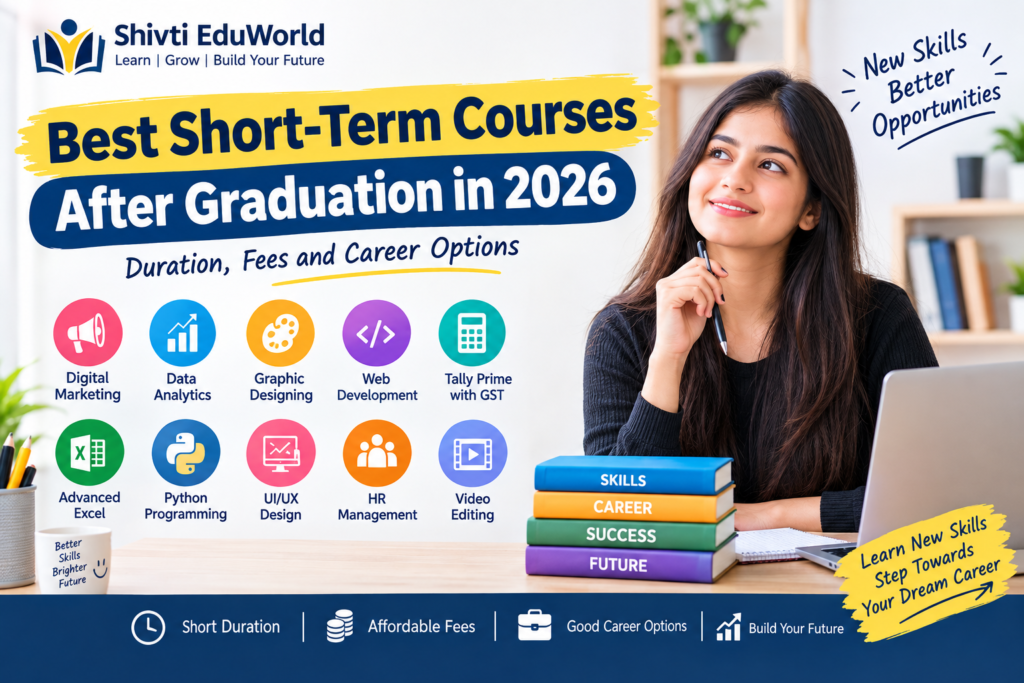
Have you completed your graduation and are wondering what to do next? A short-term course can help you learn job-ready skills without spending years on another degree.
From digital marketing and accounting to graphic design and data analytics, there are several options to explore.
Let’s look at the best short-term courses after graduation, their fees, and career opportunities.
Table of Contents
1. Digital Marketing Course
Digital marketing is a good option if you enjoy working online. It helps businesses promote products, reach customers, and grow their online presence.
What Will You Learn?
- Search Engine Optimization (SEO)
- Social Media Marketing
- Content Marketing
- Google Ads Basics
- Website Traffic Analysis
Duration: 3–6 months
Fees: Free and paid courses are available.
Career Options: SEO Trainee, Digital Marketing Assistant, and Social Media Executive.
Who Should Choose This Course?
This course is suitable for those who enjoy writing, researching, or working online. You can practise SEO to improve your blog’s visibility on Google.
2. Advanced Excel Course
Advanced Excel is a useful skill for office jobs. It helps you manage data, prepare reports, and perform calculations easily.
What Will You Learn?
- Excel Formulas and Functions
- Sorting and Filtering
- PivotTables and Charts
- Data Cleaning
- Lookup Functions
Duration: 1–3 months
Fees: Vary by institute. Free tutorials are also available online.
Career Options: Office Assistant, Reporting Assistant, and MIS Assistant.
3. Tally Prime with GST Course
Tally Prime with GST is a useful course for students interested in accounting. It teaches you how to manage business transactions and maintain financial records.
What Will You Learn?
- Basic Accounting
- Sales and Purchase Entries
- Payments and Receipts
- Ledger Management
- Inventory Management
- GST Accounting Entries
Duration: 2–6 months
Fees: Vary by institute and course syllabus.
Career Options: Accounts Assistant, Billing Assistant, and Junior Accountant.
4. Graphic Designing CourseDo you enjoy creating posters or social media posts? Graphic designing can help you turn your creativity into a useful career skill.
What Will You Learn?
- Colour Combinations and Fonts
- Poster and Banner Design
- Social Media Graphics
- Image Editing
- Canva or Adobe Photoshop
Duration: 2–6 months
Fees: Depend on the institute and software.
Career Options: Junior Graphic Designer, Design Assistant, and Social Media Designer.
5. Data Analytics Course
Data analytics is a good option if you enjoy working with numbers and information. It helps businesses understand data and make better decisions.
What Will You Learn?
- Microsoft Excel
- Data Cleaning
- Charts and Data Visualisation
- Basic Statistics
- SQL Basics
- Power BI
Duration: 3–6 months for beginner courses.
Fees: Depend on the course and training provider.
Career Options: Data Analyst Intern, Reporting Assistant, and Junior Data Analyst.
6. Web Development Course
Want to learn how websites are created? Web development teaches you to build websites that work on computers and mobile devices.
What Will You Learn?
- HTML Basics
- CSS and Styling
- JavaScript Basics
- Responsive Website Design
- Website Development Projects
Duration: 3–9 months for beginner training.
Fees: Vary by institute. Free learning resources are also available.
Career Options: Web Development Intern, Junior Web Developer, and Website Assistant.
8. UI/UX Design Course
UI/UX design focuses on making websites and apps easy to use. UI deals with the visual design, while UX focuses on the overall user experience.
What Will You Learn?
- Design Principles
- User Research Basics
- Wireframes and Prototypes
- Website and App Layouts
- Usability Testing
- Figma Basics
Duration: 3–6 months
Fees: Depend on the course and institute.
Career Options: UI Design Intern, UX Design Trainee, and Design Assistant.
9. Human Resource Management Course
Human Resource Management (HRM) focuses on recruitment and employee management. If you enjoy communication and working with people, this course may be a good option.
What Will You Learn?
- Recruitment Basics
- Resume Screening
- Interview Coordination
- Employee Records
- HR Policies
- Workplace Communication
Duration: 3–6 months
Fees: Vary by institute.
Career Options: HR Assistant, Recruitment Coordinator, and HR Trainee.
Who Should Choose This Course?
This course is suitable for graduates with good communication and organisational skills who want to start a career in human resources.
10. Video Editing Course
Video editing is a useful skill if you enjoy creating videos. Businesses, content creators, and educational platforms use videos to share information and promote products.
What Will You Learn?
- Video Cutting and Trimming
- Adding Music and Captions
- Transitions and Effects
- Audio Editing
- Colour Correction
- Basic Motion Graphics
Duration: 2–6 months
Fees: Vary by software and training provider.
Career Options: Junior Video Editor, Editing Assistant, and Content Production Assistant.
Who Should Choose This Course?
This course is suitable for creative people who enjoy making videos. Practise by editing short videos to build your skills and portfolio.
Which Course Should You Choose After Graduation?
The right course depends on what you want to do next.
| Your Goal | Course to Consider |
|---|---|
| Learn online marketing | Digital Marketing |
| Improve office skills | Advanced Excel |
| Work in accounting | Tally Prime with GST |
| Create posters and designs | Graphic Designing |
| Work with data | Data Analytics |
| Build websites | Web Development |
| Learn coding | Python Programming |
| Design apps and websites | UI/UX Design |
| Work in recruitment | HR Management |
| Edit videos | Video Editing |
You don’t need to join all these courses. Choose one that matches your interests and career plans.
How Much Do Short-Term Courses Cost?
Course fees vary widely. Some online resources are free, while paid courses may cost a few thousand rupees or considerably more.What to Check Before Enrolling
- The complete syllabus
- Course duration
- Practical training
- Certificate details
- Instructor support
- Reviews of the institute
You can explore NIELIT for short-term courses and technical training options.
You can also visit Microsoft Learn for free learning resources related to Microsoft products and technology.
Important: Always check the current course details and fees before enrolling.
How to Choose the Right Course
Still confused? Ask yourself these questions before making a decision.
1. What Type of Work Interests You?
If you enjoy creativity, consider graphic designing. If you like numbers, explore Excel or data analytics. If technology interests you, look at web development or Python.
2. What Skills Do Employers Need?
Check entry-level job descriptions in your chosen field. This will help you understand which skills are useful.
3. Can You Practise What You Learn?
Choose a course that includes practical assignments or projects. Practical knowledge helps you apply what you learn.
4. Is the Course Worth the Fee?
Compare the syllabus, teaching support, and practical training before paying.
5. Does the Course Match Your Qualifications?
Some jobs require a specific degree or qualification in addition to a certificate. Check the requirements before enrolling.
Frequently Asked Questions
1. Which short-term course is best after graduation?
The best course depends on your interests and career goals. Digital Marketing, Advanced Excel, Data Analytics, Tally Prime with GST, and Web Development are some options to consider.
2. Can I do a short-term course after graduation?
Yes, graduates can choose short-term courses to learn new skills, improve their knowledge, and prepare for different career opportunities.
3. Which short-term courses can I do for free?
You can explore free learning resources on Microsoft Learn and check NIELIT for available courses and training options.
4. How long does a short-term course take to complete?
Most short-term courses take a few weeks to several months, depending on the subject, syllabus, and training provider.
5. Can I get a job after completing a short-term course?
A short-term course can help you develop useful skills. However, getting a job depends on your practical knowledge, qualifications, experience, and employer requirements.
6. How do I choose the right course after graduation?
Choose a course based on your interests, career goals, budget, and the skills required for your preferred job. Check the syllabus and practical training before enrolling.
AI Jobs Without Coding: Career Options in 2026