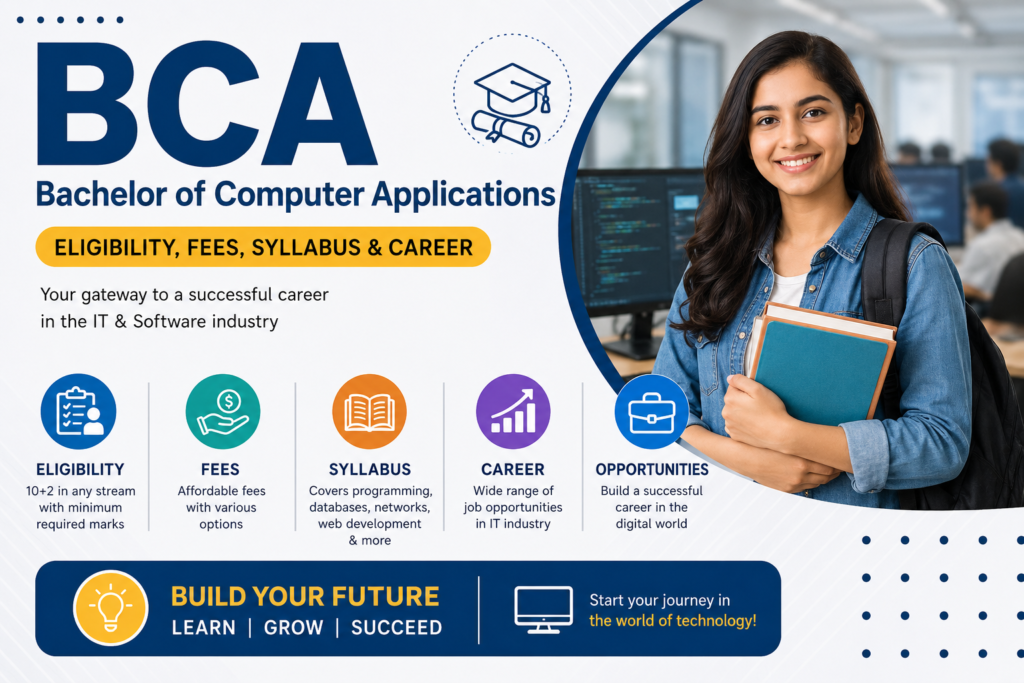
Choosing the right course after Class 12 can be an important step toward building a successful career. If you are interested in computers, programming, software development, and technology, BCA (Bachelor of Computer Applications) can be an option worth exploring.
In this BCA Course Details guide, you will find everything you need to know about BCA, including eligibility, admission process, fees, syllabus, subjects, career options, salary, higher studies, and the skills that can help you build a career in the IT sector.
BCA is generally a 3-year undergraduate programme divided into 6 semesters, although the course duration, subjects, eligibility requirements, and fee structure can vary by university. Before applying, students should always check the latest information on the official website of their chosen college or university.
Whether you are planning to pursue BCA after Class 12 or simply comparing different career options, this guide will help you understand the course, its opportunities, and the important factors to consider before taking admission.
BCA Course Highlights
| Particular | Details |
|---|---|
| Course Name | Bachelor of Computer Applications (BCA) |
| Course Level | Undergraduate |
| Duration | Generally 3 Years |
| Semesters | Usually 6 Semesters |
| Eligibility | 10+2 or Equivalent Examination |
| Popular Subjects | Programming, DBMS, Web Development, Networking |
| Career Area | IT, Software & Technology |
| Higher Studies | MCA, MSc Computer Science, MBA & Other Courses |
2. What is BCA?
BCA stands for Bachelor of Computer Applications. It is an undergraduate course for students interested in computers, programming, and technology. During BCA, students learn about programming, web development, databases, software, and other computer-related subjects. The course is generally completed in 3 years.
3. BCA Eligibility Criteria
Thinking about doing BCA after Class 12? The good news is that many colleges accept students from different streams, so you do not always need to be from a Science background.
Generally, you need to::
- Complete Class 12th or an equivalent examination from a recognized board.
- Meet the minimum percentage required by the college or university.
- Some colleges may accept Arts, Commerce, and Science students.
- Certain universities may require or prefer Mathematics or Computer Science in Class 12.
The eligibility rules can be different from one college to another. So, before applying, make sure to check the latest eligibility criteria on the official website of the college you are interested in.
4. BCA Admission Process
| Step | Admission Process |
|---|---|
| 1. Choose a College | Select a BCA college based on your course preference, budget, and eligibility. |
| 2. Check Eligibility | Check the college’s latest eligibility requirements before applying. |
| 3. Fill the Application Form | Visit the official college website and complete the BCA application form. |
| 4. Entrance Exam | If required, appear for the college or university entrance exam. |
| 5. Selection | Admission may be offered through merit, entrance exam results, or the college’s selection process. |
| 6. Document Verification | Submit the required documents for verification. |
| 7. Pay the Fees | Pay the required admission fee to confirm your BCA seat. |
5. BCA Fees
BCA Fees
The BCA Fees can vary depending on the type of college and university. Government colleges are generally more affordable, while private colleges may have higher fees.
| College Type | Approx. BCA Fees |
|---|---|
| Government Colleges | ₹10,000 – ₹50,000 per year |
| Private Colleges | ₹50,000 – ₹1,50,000+ per year |
| Online BCA | Varies by university and programme |
Note: These are approximate fee ranges. The actual fee may vary from one college to another. Always check the latest fee structure on the official college website before taking admission.

BCA Subjects
BCA subjects can vary between universities, but most programmes cover a combination of programming, computer applications and information technology topics.
Common BCA subjects may include:
- Computer Fundamentals
- Programming in C
- Data Structures
- Object-Oriented Programming
- Database Management Systems
- Computer Networks
- Operating Systems
- Web Development
- Java Programming
- Python
- Software Engineering
- Cybersecurity
- Cloud Computing
- Artificial Intelligence
- Data Analytics
- Project Work
The exact subjects, semester structure and practical components may differ by university, so students should check the official syllabus of the institution they plan to join.
6. Skills You Can Develop After BCA
A BCA course can help you develop useful skills for a career in the IT sector. You can learn programming, web development, database management, computer networking, and software development. Along with technical knowledge, BCA can also improve your problem-solving, logical thinking, communication, and project-handling skills. These skills can help you prepare for different job roles and higher studies in the technology field.
7. Career Options After BCA
After completing BCA, graduates can apply for various entry-level positions in the IT and software industry. Some popular career options after BCA include:
1. Software Developer
Software developers create, test, and maintain software applications. Strong programming and problem-solving skills can help students build a career in this field.
2. Web Developer
Web developers create and maintain websites and web applications. Knowledge of HTML, CSS, JavaScript, and backend technologies can be useful.
3. Data Analyst
Students interested in data can explore data analyst roles by developing skills in Excel, SQL, Python, statistics, and data visualization.
4. Database Administrator
Database professionals manage and maintain databases and help organizations keep their data secure and accessible.
5. IT Support Specialist
IT support professionals help users solve computer, software, network, and technical problems.
6. Cybersecurity Professional
Students interested in security can learn networking, ethical hacking, security tools, and risk management to explore cybersecurity careers.
7. Mobile App Developer
Students with programming skills can specialize in Android, iOS, or cross-platform application development.
8. Top Recruiters After BCA
Some well-known companies that hire BCA graduates include TCS, Infosys, Wipro, Accenture, HCLTech, Cognizant, Capgemini, IBM, and Deloitte. Hiring depends on the company, job role, eligibility, and your skills.
9. BCA Salary in India
| Experience | Average Salary |
| Freshers | ₹3 – ₹5 LPA |
| 2–5 Years | ₹5 – ₹8 LPA |
| Experienced Professionals | ₹8 – ₹15+ LPA |
10. Higher Studies After BCA
After completing BCA, you can choose higher studies to build deeper knowledge and better career opportunities. Popular options include MCA, MSc Computer Science, MBA, and postgraduate courses in Data Science, AI, or Cybersecurity. The right choice depends on your interests and career goals.
11. Is BCA a Good Career Option?
Yes, BCA can be a good career option if you are interested in computers, technology, and programming. It can help you build technical skills and explore different careers in the IT sector. After BCA, you can start working or pursue higher studies like MCA. Your skills, experience, and interests will play an important role in your career growth.
12. Conclusion
BCA is a useful undergraduate course for students who want to enter the IT and software industry after 12th. The course usually takes three years and covers important areas such as programming, databases, web development, networking, and software engineering.Before taking admission, students should carefully compare the BCA eligibility, fees, syllabus, college reputation, placement support, and career opportunities. With the right skills and practical experience, BCA can provide a strong foundation for a career in the technology sector.
Frequently Asked Questio1.
Q1. What is BCA?
BCA stands for Bachelor of Computer Applications. It is an undergraduate course that focuses on programming, software development, databases, networking, and computer applications.
Q2. What is the duration of a BCA course?
The BCA course is generally 3 years long, divided into 6 semesters. The duration may vary according to the university.
Q3. What is the eligibility for BCA?
Students who have completed Class 12th or an equivalent examination from a recognized board can generally apply for BCA. Eligibility requirements may vary by college.
Q4. What is the BCA course fee?
BCA fees vary depending on the college, university, and mode of study. Government and distance-learning institutions may have lower fees, while private colleges can charge more.
Q5. What subjects are taught in BCA?
Common BCA subjects include programming, data structures, DBMS, computer networks, operating systems, web development, and software engineering.
Q6. Can Commerce or Arts students do BCA?
Yes, many universities allow Commerce and Arts students to pursue BCA. However, some colleges may have specific subject or mathematics requirements.
Q7. What are the career options after BCA?
After BCA, students can explore careers such as Software Developer, Web Developer, Data Analyst, IT Support Specialist, Database Administrator, and Mobile App Developer.
Q8. Can I do MCA after BCA?
Yes, BCA graduates can pursue MCA (Master of Computer Applications), subject to the eligibility criteria of the university.
Q9. Is BCA a good career option?
Yes, BCA can be a good option for students interested in computers, programming, and technology. Developing practical skills and gaining internship experience can improve career opportunities.
Top 10 BCA Colleges in India: Unlock Your Dream Future
Top 10 MBA Colleges in India | Best Guide 2026
Top Engineering Colleges in India: Best 10 for Success
Top Career Options After 12th | Science, Commerce & Arts
GLA University Admission 2026: Complete Guide
AKTU Admission 2026: Complete Guide to Eligibility &Process
Best Career Options After 12th Arts
Best Career Options After 12th Commerce