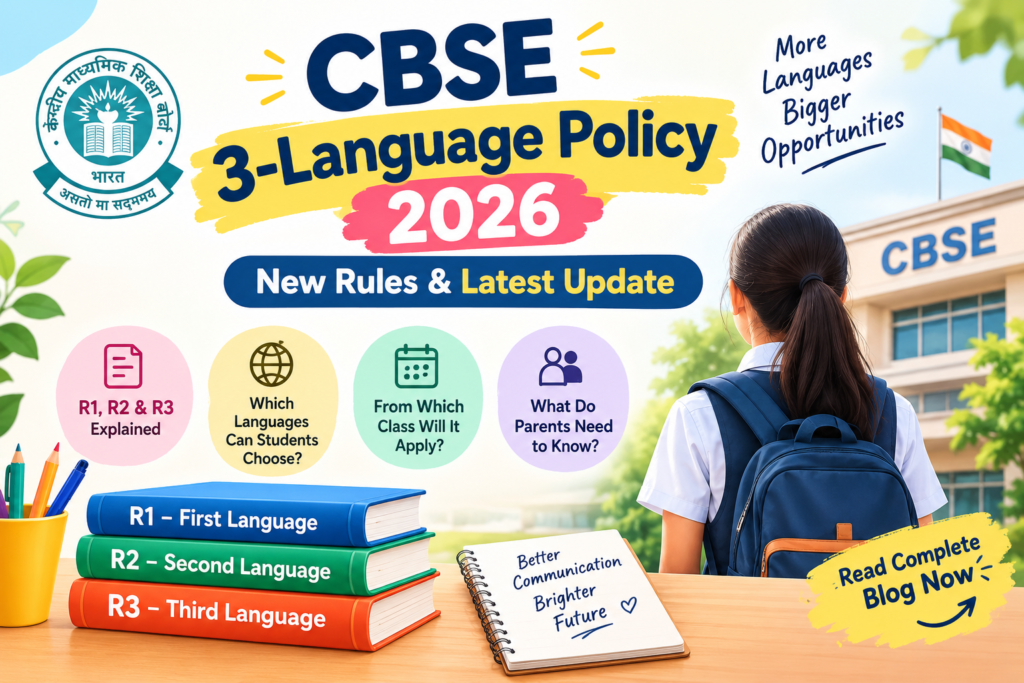
The CBSC 3-Language Policy 2026 is an important change in the school curriculum as CBSE moves towards the recommendations of the National Education Policy (NEP) 2020 and the National Curriculum Framework for School Education (NCF-SE) 2023.
Under the updated framework, students are required to study three languages at the applicable stage, with the policy placing greater emphasis on Indian languages.
Table of Contents
What Is the CBSE 3-Language Policy 2026?
The CBSE 3-language policy follows the R1, R2 and R3 structure.
- R1: First Language
- R2: Second Language
- R3: Third Language
The third language is being introduced as part of the implementation of the multilingual education framework.
CBSE’s 2026-27 curriculum states that R3 (Third Language) is to be made compulsory from Class VI and Class IX, in line with the recommendations of NEP 2020 and NCF-SE 2023.

What Is R3 or the Third Language?
R3 refers to the third language studied by a student in the three-language structure. The purpose of R3 is not simply to add another examination subject. The curriculum focuses on developing students’ communication, comprehension, reading and writing abilities while encouraging greater exposure to languages and cultures.
CBSE’s implementation guidance also highlights communication and language skills as important areas of R3 learning.
Are Three Languages Compulsory for Students?
Important Update: Implementation of CBSE’s Three-Language Structure
- Phased Rollout: The revised CBSE language structure is being introduced in phases across schools.
- New Batches: Students entering the newly applicable classes under the revised curriculum must follow the mandatory language combinations.
- Existing Batches: Transition arrangements may apply to students who are already studying in specific ongoing classes.
- Action Required: Parents should review the latest circular issued by their school to confirm the exact language options available for their child.
What Does the New Policy Say About Indian Languages?
A key highlight of the revised CBSE framework is its strong emphasis on Indian languages. The policy is designed around multilingual education, actively encouraging students to learn native Indian languages alongside other subjects. Since every school may offer different language choices, students and parents should carefully check their school’s specific curriculum to confirm the exact language combination allowed for their particular class.
Is Hindi Compulsory Under the 3-Language Policy?
Students and parents should not assume that this policy makes studying Hindi mandatory for everyone. The three-language framework offers a flexible variety of language combinations, subject to CBSE guidelines and the specific options available at each school. Consequently, the exact language subjects a student will study depend entirely on their grade, their school’s offerings, and the specific curriculum applicable to them.
Will There Be a Board Exam for R3?
The assessment of the third language depends on the applicable CBSE scheme and the student’s batch. For the transition arrangements announced for the current classes, CBSE has clarified that students following the existing arrangements should continue according to the applicable scheme.
Parents should therefore avoid relying on social-media posts claiming that every student will immediately have a separate Class 10 Board Examination for R3.

Why Has CBSE Introduced the Three-Language Policy
This language policy directly aligns with the broader, visionary goals of NEP 2020 and NCF-SE 2023.
The major objectives include:
- Promoting Multilingual Education: Actively encouraging the study of multiple languages to foster cognitive growth.
- Improving Communication Skills: Enhancing core interpersonal and expressive linguistic abilities.
- Increasing Exposure to Indian Languages: Nurturing a deeper connection with and utilization of native Indian languages.
- Developing Reading & Writing Abilities: Strengthening foundational literacy across different language combinations.
- Encouraging Cultural Understanding: Cultivating social tolerance and deep cross-cultural appreciation.
- Supporting Holistic Learning: Integrating diverse disciplines to build well-rounded educational outcomes.
What Should Students and Parents Do Now?
Students should first check their school’s official language options and current subject combination.
Parents can also ask the school:
- Which language is being offered as R1?
- Which language is being offered as R2?
- Which language is available as R3?
- From which class will the third language apply?
- How will R3 be assessed?
- Which curriculum and textbooks will be followed?
CBSE 3-Language Policy 2026: Key Points
Conclusion
The CBSE 3-Language Policy 2026 is an important curriculum change aimed at strengthening multilingual education. The introduction and implementation of R3 will affect students according to their class and applicable transition rules.
Since CBSE is implementing the policy in phases, students and parents should follow the latest official CBSE notification and their school’s instructions instead of relying on unofficial information. As the implementation progresses, schools may also issue further updates regarding language choices, textbooks and assessment.
Top Career Options After 12th | Science, Commerce & Arts